What to see in Genoa: 3 elegant historic cafes in the center
Updated: 6 days ago
Discover three historic cafés in Genoa
between chic breakfasts, afternoon teas and elegant aperitifs in the Caruggi.
Genoa has a rare talent: mixing the popular soul of its caruggi with a refinement that appears suddenly, almost by magic.
You walk through fry shops that smell of hot farinata and, around the corner, you find yourself in a 19th-century hall where time seems to have stood still, among hand-polished wood paneling and decorated porcelain.
It is this play of contrasts —spontaneous, sincere, surprising— that makes the Genoese alleys so fascinating. Those who travel them without haste discover an intimate, authentic, deeply elegant city without ever flaunting it.
And it is precisely this secret Genoa that I want guests of P&P House to experience.
In the heart of the caruggi, the Pasticceria Liquoreria Marescotti is much more than a stop: it is a privileged entrance to another era.
For our guests, it's almost a ritual, because right here they pick up the keys to our apartment and begin their stay.
Cafes that have welcomed musicians, writers, and curious travelers, and which still retain their aristocratic charm intact today.
Three perfect addresses for those seeking an elegant awakening, a traditional but well-kept lunch, an afternoon tea served as a ritual or a daytime aperitif in complete tranquility.
The most beautiful thing? They are all located just a few minutes from the Porto Antico, the Aquarium and Piazza Fossatello: an ideal triangle for those staying at our “Acquario House”.

First stop: Pasticceria Liquoreria Marescotti
In the heart of the caruggi, the Pasticceria Liquoreria Marescotti is much more than a stop: it is a privileged entrance to another era.
For our guests it is almost a ritual, because right here we serve the official breakfast of the stay.
Why start with Marescotti
Marescotti is one of those places where memory rests on every detail: the inlaid wood paneling, the original floors, the porcelain cups, the scent of almonds and freshly ground coffee.
You don't just enter to eat a dessert: you enter to experience a fragment of Genoese history, told with grace and silence.

Discover the history of Marescotti
Entering Pasticceria Liquoreria Marescotti means crossing a threshold that separates not simply the inside from the outside, but the present from the past.
As the years went by, Marescotti didn't just remain what it was: it transformed, it expanded, it became a meeting point. From a simple resale, it has evolved into a city living room, while retaining a distinctive feature that no restoration can ever recreate: its authentic Art Nouveau soul.
The original wood paneling, the crystal display cases, the brass chandeliers, the woods darkened by the years and polished by care: every detail is still the same as it was then. Strolling through its rooms means touching Genoa in the early twentieth century and feeling it alive.
Marescotti has become much more than a pastry shop.
It is a cultural, emotional, social place.
Founded in 1906 as an elegant grocery store, Marescotti offered pure cocoa, tea and coffee from distant routes, fine liqueurs and handmade sugars. Over time it transformed into a city living room, preserving its authentic Art Nouveau soul
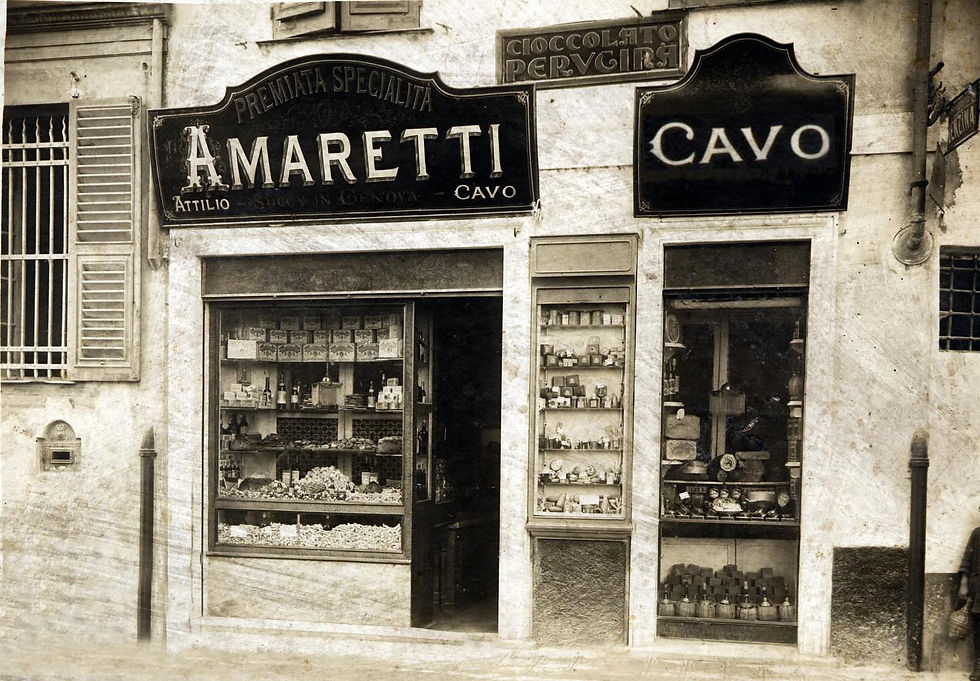
Today, the custodian of this place is Stefania, 26 years old, who we asked with what eyes lives every day a place born 245 years ago.
-" With much humility and deep respect. When you find yourself cherishing a 245-year history, you immediately realize you're just passing through: the place belongs to the memory of Genoa and its people. Crossing that threshold every morning is a great honor for me, but also a daily responsibility that I try to face in small steps, listening to those who have always frequented this place and trying to offer a thoughtful and sincere welcome every day."-

If I had to choose a Marescotti dessert as a "business card" for Genoa, what would it be?
-"Besides Voltaggio's amaretto, I love offering Torta Mazzini. It's a special dessert for me because we prepare it carefully following the ancient and original recipe written by Giuseppe Mazzini himself in a letter sent to his mother by one of his exiles. And then there are our mini-Gobeletti with jam, the right accompaniment for coffee.

A curiosity: the recipe for Torta Mazzini actually exists, written by Mazzini in December 1835 during his exile in Switzerland, in a letter to his mother Maria Drago, a piece of the Risorgimento that can still be tasted, with a puff pastry shell and a filling scented with almonds and lemon.
Regarding the details of the place she's most attached to, Stefania explains exactly what our guests discover with their own eyes every time they come to collect their keys:
"The boiserie drawers fascinate me so much: they still preserve the hand-made engravings from that era, where details of what they contained were noted. And then there is the Madonna del Dito, the small painting placed above the central mirror. He is a discreet figure, a protective presence typical of the ancient historic workshops of the past. For me it represents continuity, the thin thread that holds the past of this place together with our present. There is also another detail that few immediately notice: the original marble floor, with decorative shell motifs that recall Rubens' style.


Second stop: La Corte di Romanengo
Just minutes from Marescotti, in the heart of the vibrant Piazza Soziglia, where the air smells of spices, buzz, and historic shops, lies one of the most striking contrasts in the historic center.
Just crossing the threshold of the Romanengo Court is enough to find yourself in another dimension: outside the continuous movement of the square, inside a soft, measured, almost incredible silence.
It's like going from the close-up of a work to the most delicate interlude.
Thin porcelain, soft lights, ancient scents: everything invites you to slow down, to breathe, to indulge in a moment for yourself.
Perfect for afternoon tea, to discover the famous candied fruits or for those who want an elegant and private experience right in the heart of the most vibrant city.
La Corte is the tea room connected to the historic Romanengo confectionery, a place of young birth that allows you to experience the brand's tradition in a new way: not just by looking at it from the windows, but by savoring it.

Curiosities to enjoy (almost) as much as candied fruit
A family tradition that was born in the eighteenth century
Romanengo is considered the oldest still active confectionery in Italy, founded by Pietro Romanengo on the historic Via Soziglia.
Illustrious guests of the workshop
The historical registers include Giuseppe Verdi, the Duchess of Aosta and the charismatic Ira von Fürstenberg.
Original vintage details
Mirrors, fine woods, a shell-shaped marble sink: elements that recall the Parisian workshops of the late eighteenth century.
The symbol of the dove
The dove with the olive branch is the founder's historic mark, chosen as a wish for peace in a Europe that has just returned to tranquility.
Leaving La Corte Romanengo means suddenly returning to the lively pace of the caruggi.
Outside you are greeted by the full square, the calls of the shopkeepers, the light on the shops; inside still remains, for a few minutes, the feeling of having tasted something rare.
And this abrupt yet fascinating change of atmosphere is exactly what makes our next stop special: a place where mirrors amplify stories, light, and conversations, transforming it into an urban living room waiting to be discovered.

Third stage: Il Caffè degli Specchi. (the coffee of mirrors)
Leaving the liveliness of Piazza Soziglia, it only takes a few steps to find yourself in a different atmosphere.
Caffè degli Specchi has transformed an ancient Genoese café into a modern and bright living room, without losing its connection with the past.
The main hall is adorned with 19th-century mirrors that multiply light and create a refined play of reflections. The renovation respected the original soul, incorporating contemporary elements: light marble, minimal lines, and gathered tables.
Here simplicity becomes elegance: even a coffee served on the go seems better, more refined.
The place accompanies every moment of the day:
breakfasts with scones, brioches and traditional cakes,
light and well-groomed lunches,
afternoons with biscuits and small pastry shop,
refined but informal aperitifs.
It's the perfect end to the route: a return to contemporary Genoa after two stops steeped in history.

Concluding
Why choose Genoa's historic cafes
Staying at BnB Acquario House means having the city at your fingertips. After a stroll through museums and caruggi, treating yourself to a coffee or dessert in one of these historic establishments is the best way to feel part of Genoa's history.


Manu's advice
Don't leave without bringing the memory of a taste. Among the many proposals I suggest:
Voltaggio's amaretto (trust me: Genoa tells the story of more than a thousand words)
a Romanengo candied fruit to understand what tradition really is
the lasagna of the Mirrors au “tuccu” (unforgettable).
Manuela Scarcella is the newest addition to the P&P House team, but her professional career in the hospitality world began over twenty years ago.
Today she describes Genoa with the gaze of someone who knows the toil and beauty of hospitality: attentive to details, silences, small gestures that transform a stay into an experience
Photo credits: Original photos by Manuela Scarcella and Caterina Conti. Web images from the official website of Corte Romanengo and Caffè degli Specchi


Comments